A LETTER TO THE FARMERS
—OF THE GREAT—
Hog Raising and Corn Growing Territory
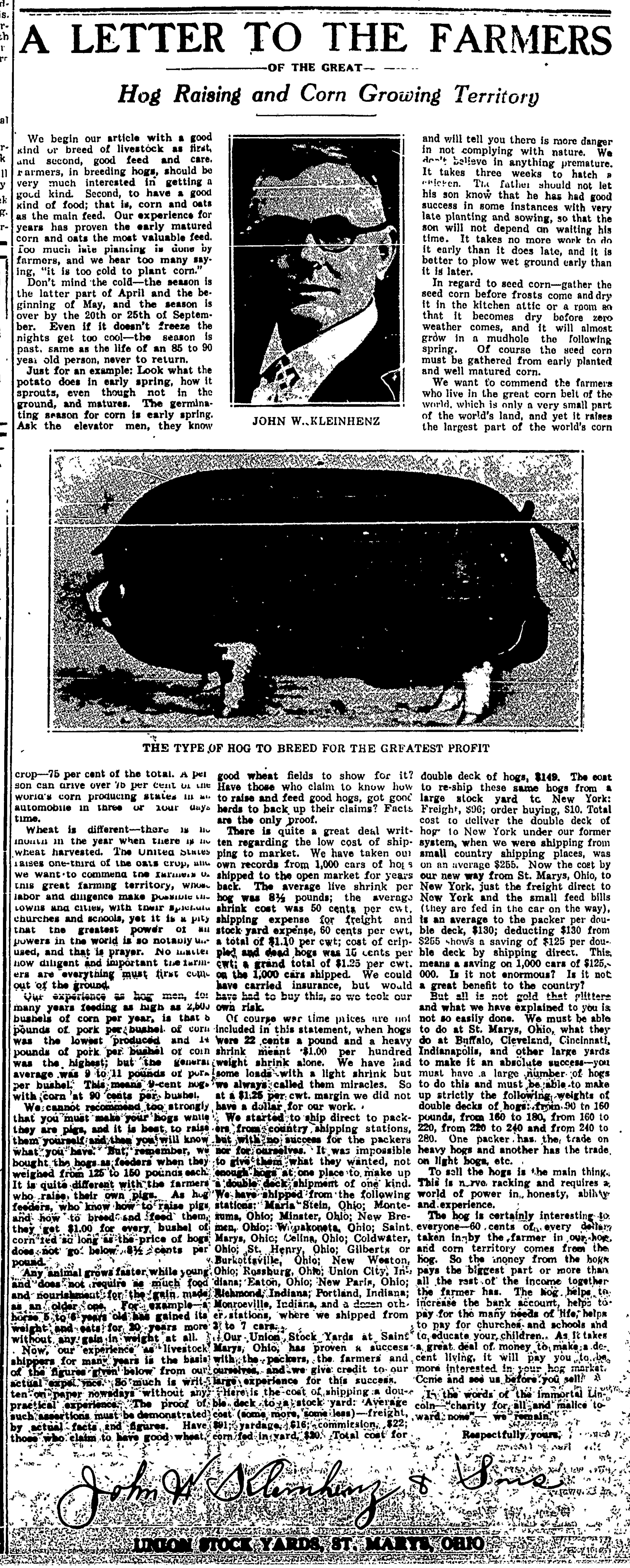
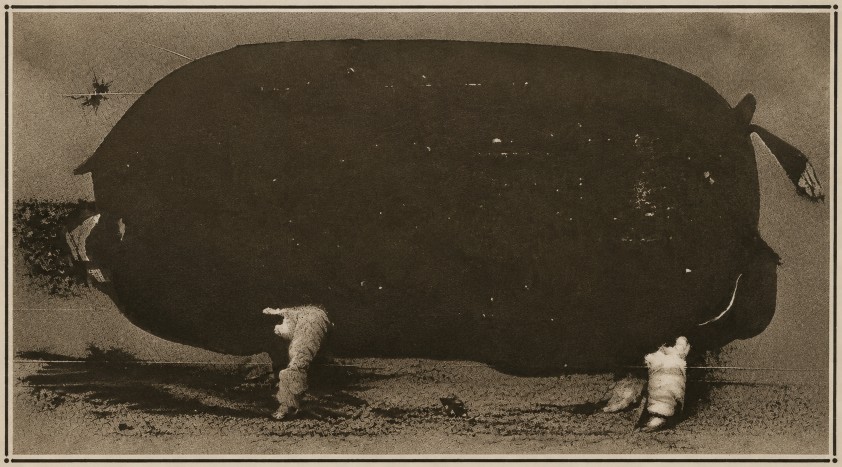
We begin our article with a good kind or breed of livestock as first, and second, good feed and care. Farmers, in breeding hogs, should be very much interested in getting a good kind. Second, to have a good kind of feed; that is, corn and oats as the main feed. Our experience for years has proven the early matured corn and oats the most valuable feed. Too much late planting is done by farmers, and we hear too many saying, "it is too cold to plant corn."
Don't mind the cold—the season is the latter part of April and the beginning of May, and the season is over by the 20th or 25th of September. Even if it doesn't freeze the nights get too cool—the season is past, same as the life of an 85 to 90 year old person, never to return.
Just for an example: Look what the potato does in early spring, how it sprouts, even though not in the ground, and matures. The germinating season for corn is early spring. Ask the elevator men, they know and will tell you there is more danger in not complying with nature. We don't believe in anything premature. It takes three weeks to hatch a chicken. The father should not let his son know that he has had good success in some instances with very late planting and sowing, so that the son will not depend on waiting his time. It takes no more work to do it early than it does late, and it is better to plow wet ground early than it is later.
In regard to seed corn—gather the seed corn before frosts come and dry it in the kitchen attic or a room so that it becomes dry before zero weather comes, and it will almost grow in a mudhole the following spring. Of course the seed corn must be gathered from early planted and well matured corn.
We want to commend the farmers who live in the great corn belt of the world, which is only a very small part of the world's land, and yet it raises the largest part of the world's corn crop—75 per cent of the total. A person can drive over 75 per cent of the world's corn producing states in an automobile in three or four days' time.
Wheat is different—there is no month in the year when there is no wheat harvested. The United States raises one-third of the oats crop, and we want to commend the farmers of this great farming territory, whose labor and diligence make possible the towns and cities, with their splendid churches and schools, yet it is a pity that the greatest power of all powers in the world is so notably unused, and that is prayer. No matter how diligent and important the farmers are everything must first come out of the ground.
Our experience as hog men, for many years feeding as high as 2,500 bushels of corn per year, is that 5 pounds of pork per bushel of corn was the lowest produced and 14 pounds of pork per bushel of corn was the highest; but the general average was 9 to 11 pounds of pork per bushel. This means 9-cent hogs with corn at 90 cents per bushel.
We cannot recommend too strongly that you must make your hogs while they are pigs, and it is best to raise them yourself, and then you will know what you have. But, remember, we bought the hogs as feeders when they weighed from 125 to 150 pounds each. It is quite different with the farmers who raise their own pigs. As pig feeders, who know how to raise pigs and how to breed and feed them, they get $1.00 for every bushel of corn fed as long as the price of hogs does not go below 8½ cents per pound.
Any animal grows faster while young and does not require as much food and nourishment for the gain made as an older one. For example—a horse 5 to 6 years old has gained its weight and eats for 20 years more without any gain in weight at all.
Now, our experience as livestock shippers for many years is the basis of the figures given below from our actual experience. The proof of such assertions must be demonstrated by actual facts and figures. Have those who claim to have good wheat fields to show for it? Have those who claim to know how to raise and feed good hogs, got good herds to back up their claims? Facts are the only proof.
There is quite a great deal written regarding the low cost of shipping to market. We have taken our own records from 1,000 cars of hogs shipped to the open market for years back. The average live shrink per hog was 8¾ pounds; the average shrink cost was 50 cents per cwt; shipping expense for freight and stock yard expense, 60 cents per cwt, a total of $1.10 per cwt; cost of crippled and dead hogs was 10 cents per cwt; a grand total of $1.25 per cwt. on the 1,000 cars shipped. We could have carried insurance, but would have had to buy this, so we took our own risk.
Of course war time prices are not included in this statement, when hogs were 22 cents a pound and a heavy shrink meant $1.00 per hundred weight shrink alone. We have had some loads with a light shrink but we always called them miracles. So at a $1.25 per cwt. margin we did not have a dollar for our work.
We started to ship direct to packers from country shipping stations, but with no success for the packers nor for ourselves. It was impossible to give them what they wanted, not enough hogs at one place to make up a double deck shipment of one kind. We have shipped from the following stations: Maria Stein, Ohio; Montezuma, Ohio; Minster, Ohio; New Bremen, Ohio; Wapakoneta, Ohio; Saint Marys, Ohio; Celina, Ohio; Coldwater, Ohio; St. Henry, Ohio; Gilberts or Burketsville, Ohio; New Weston, Ohio; Rossburg, Ohio; Union City, Indiana; Eaton, Ohio; New Paris, Ohio; Richmond, Indiana; Portland, Indiana; Monroeville, Indiana, and a dozen other stations, where we shipped from 3 to 7 cars.
Our Union Stock Yards at Saint Marys, Ohio, has proven a success with the packers, the farmers and ourselves, and we give credit to our large experience for this success. Here is the cost of shipping a double deck to a stock yard: Average cost (some more, some less)—freight, $91; yardage, $16; commission, $22; corn fed in yard, $20. Total cost for double deck of hogs, $149. The cost to re-ship these same hogs from a large stock yard to New York: Freight, $96; order buying, $10. Total cost to deliver the double deck of hogs to New York under our former system, when we were shipping from small country shipping places, was on an average $255. Now the cost by our new way from St. Marys, Ohio, to New York, just the freight direct to New York and the small feed bills (they are fed in the car on the way), is an average to the packer per double deck, $130; deducting $130 from $255 shows a saving of $125 per double deck by shipping direct. This means a saving on 1,000 cars of $125,000. Is it not enormous? Is it not a great benefit to the country?
But all is not gold that glitters and what we have explained to you is not so easily done. We must be able to do at St. Marys, Ohio, what they do at Buffalo, Cleveland, Cincinnati, Indianapolis, and other large yards to make it an absolute success—you must have a large number of hogs to do this and must be able to make up strictly the following weights of double decks of hogs: from 90 to 160 pounds, from 160 to 180, from 180 to 220, from 220 to 240 and from 240 to 280. One packer has the trade on heavy hogs and another has the trade on light hogs, etc.
To sell the hogs is the main thing. This is nerve racking and requires a world of power in honesty, ability and experience.
The hog is certainly interesting to everyone—60 cents of every dollar taken in by the farmer in our hog and corn territory comes from the hog. So the money from the hogs pays the biggest part or more than all the rest of the income together the farmer has. The hog helps to increase the bank account, helps to pay for the many needs of life, helps to pay for churches and schools and to educate your children. As it takes a great deal of money to make a decent living, it will pay you to be more interested in your hog market. Come and see us before you sell!
In the words of the immortal Lincoln "charity for all, and malice toward none" we remain.
Respectfully yours,
John W. Kleinhenz
UNION STOCK YARDS, ST. MARYS, OHIO